IoT WiFi modules are essential components for connecting devices to the internet, enabling remote control, data collection, and automation across smart homes and industrial applications. This article reviews some of the best IoT WiFi modules available on Amazon, highlighting their key features and compatibility to help you make an informed choice.
| Product | Brand | Key Feature |
|---|---|---|
| HiLetgo ESP8266 ESP-01 Serial WiFi Module | HiLetgo | Supports AP, STA, AP+STA modes with powerful on-board processing |
| JESSINIE ESP-01M ESP8285 WiFi Module | JESSINIE | Ultra-low power 32-bit MCU with multiple sleep modes and ADC support |
| Walfront 8-Channel Smart Relay Module with WiFi & BLE | Walfront | 8 channel relay board with WROOM-32E, ideal for smart home automation |
| SDATEKIT ESP32-WROOM-32E Development Board | SDATEKIT | Certified ESP32 module with dual-core 240MHz CPU and USB-C support |
| Rain Bird LNK2 Smart WiFi Module (2nd Gen) | Rain Bird | Upgrades Rain Bird irrigation timers for remote app control |
HiLetgo ESP8266 ESP-01 Serial WiFi Module

The HiLetgo ESP8266 ESP-01 provides a powerful wireless transceiver module suitable for IoT projects requiring WiFi connectivity. This module supports three modes of operation—Access Point (AP), Station (STA), and both AP+STA—enabling flexible network setups. It features robust on-board processing and data storage capabilities, making it ideal for integration with Arduino boards and other microcontrollers. Its compact size and reliable wireless performance suit smart home devices, sensor nodes, and basic automation tasks.
JESSINIE ESP-01M Wireless Module ESP8285 WiFi

The JESSINIE ESP-01M uses the ESP8285 SoC, featuring a built-in ultra-low power 32-bit microcontroller with 80 MHz to 160 MHz frequency options. This WiFi module supports the IEEE 802.11b/g/n standards and integrates multiple interfaces, including UART, GPIO, ADC, PWM, SPI, and I2C for versatile connectivity. Deep sleep mode lowers power consumption to as little as 20 microamps, making it highly efficient for battery-powered IoT devices. It includes a precision 10-bit ADC and 1MB or 2MB flash memory for program and data storage.
Walfront 8-Channel Smart Relay Module with WiFi & BLE

The Walfront 8-Channel Smart Relay Module incorporates the WROOM-32E dual-mode module combining both WiFi and Bluetooth Low Energy (BLE) connectivity. It supports a broad voltage input range of DC 5–30V and offers eight relay channels suited for smart home automation, industrial control, and secondary development. All input/output ports and UART program download ports are easily accessible for developers looking to customize and expand applications. This module benefits from a large 4MB Flash memory, ensuring ample space for firmware and reference code.
SDATEKIT ESP32-WROOM-32E Development Board USB-C
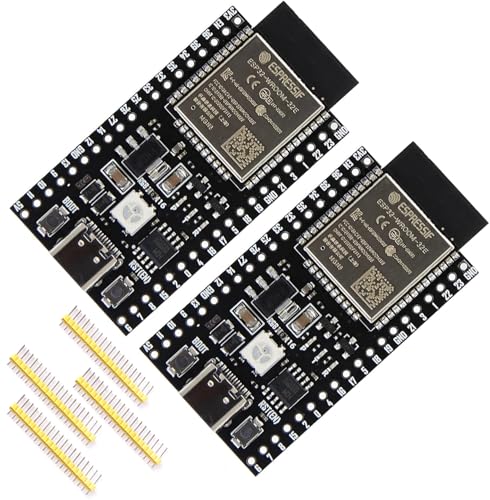
The SDATEKIT ESP32-WROOM-32E development board is Espressif-certified, promising lifetime firmware support and hardware compatibility. Powered by a 240MHz dual-core processor, it features 4MB of flash memory and Bluetooth 5.0 alongside WiFi, catering to complex IoT applications. It includes 38 general-purpose input/output pins, which support SPI, I2C, and UART interfaces for connecting sensors, displays, and motors. The board supports plug-and-play with pre-installed USB-C drivers on Windows, Mac, and Linux, compatible with Arduino IDE and MicroPython environments.
Rain Bird LNK2 Smart WiFi Module (2nd Generation)

The Rain Bird LNK2 Smart WiFi Module upgrades compatible Rain Bird irrigation timers for remote control via mobile devices. Compatible with select controllers made after November 2016, it installs in seconds and enables scheduling and programming from Apple iOS and Android apps. This second-generation WiFi module enhances water-saving irrigation management, offering advanced features remotely accessible worldwide. It’s designed for users seeking to integrate smart irrigation controls without replacing existing hardware.
Buying Guide for IoT WiFi Modules
Choosing the right IoT WiFi module depends on your project’s needs and technical requirements. Consider the following:
Compatibility and Integration
Ensure the module supports your existing microcontroller platform, whether Arduino, Raspberry Pi, or custom boards. Check supported interfaces like UART, SPI, I2C, and GPIO pins for sensor and actuator connectivity.
Wireless Functionality
Modules can offer WiFi only or a combination of WiFi and Bluetooth. Select modules that support your desired wireless standards (802.11b/g/n) and modes (AP, Station) to suit your networking setup.
Processing and Memory
Integrated processors and flash memory size impact the complexity of applications you can run. Dual-core processors with ample flash support multitasking and advanced IoT firmware with ease.
Power Consumption
For battery-operated projects, look for modules with low power modes such as deep sleep and ultra-low power MCUs. These extend device lifespan significantly.
Development Support and Tools
Modules with driver support, development libraries, and compatibility with popular IDEs like Arduino IDE or MicroPython simplify programming and debugging.
Physical Size and Form Factor
Consider the module’s footprint and pin layout for your device enclosure and PCB design. Smaller modules are better suited for compact projects.
Additional Features
Some modules include built-in OLED displays, relay control boards, or advanced sensors. Such features can reduce the need for extra components and speed up prototyping.
Taking these factors into account will help select the best IoT WiFi module tailored to your specific applications, whether home automation, industrial control, or educational projects.